
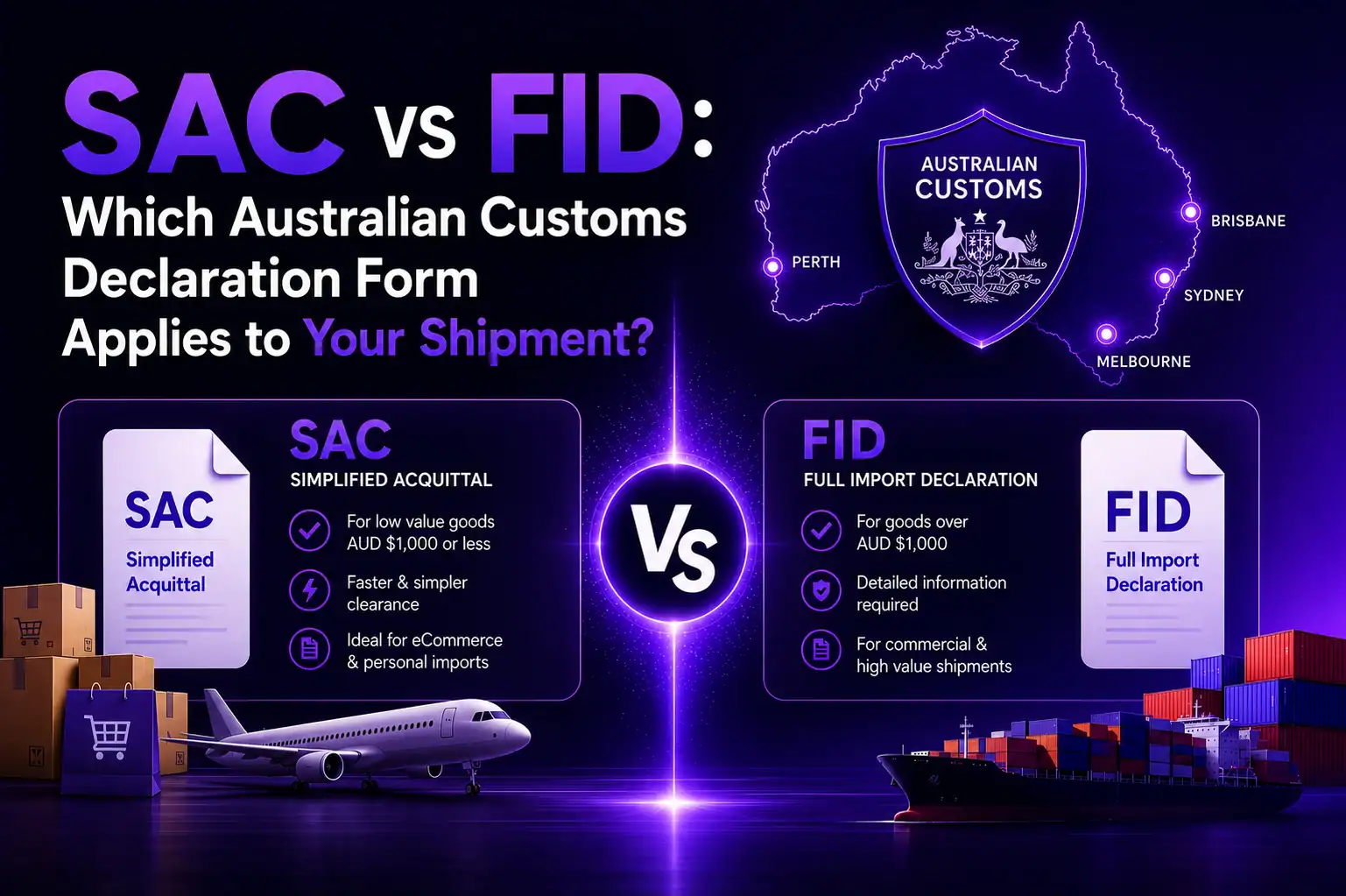
Incorrect documentation when importing into Australia can lead to instant border seizures, expensive storage charges and major delays to your supply chain. The Australian Border Force (ABF) has a threshold of AUD $1,000 for the legal streams of imports: low value imports and formal commercial imports. The choice of whether to use a Self-Assessed Clearance (SAC) declaration or a Full Import Declaration (FID) can have a direct impact on your duty liabilities, processing times and overall clearance costs for your eCommerce business and cross-border logistics operators.
These are the particular regulatory requirements, costs and submission procedures you need to know to determine which customs declaration form for Australia you need to use for your consignment. Read on for a detailed analysis!
What Is an Australian Customs Declaration?
An Australian customs declaration form is a legal document that is filed with the Australian Border Force (ABF) detailing your commodity imports. Beyond being a mere formality, a customs declaration will inform the ABF authorities of what goods you have imported, their customs declaration valuation, origin, and final destination.
This is important for ABF to determine the correct tariff classification, and to find out if any customs duty and Goods and Services Tax (GST) is payable, as well as to conduct biosecurity inspections. Unreliable and/or incomplete declarations may cause logistical problems and administrative penalties. If you are an international business seeking an effective way to deliver, the declaration form is the crucial first step towards a successful DDP delivery.
The AUD $1,000 Threshold: The Line That Decides Everything
The thing you need to consider when filling in your customs declaration form for Australia is the AUD $1,000 threshold. Australia Border Force (ABF) classifies your shipment depending on the CV value of your consignment into two categories.
Shipments Under AUD $1,000: If your shipment’s CV value is under AUD $1,000 then it is considered a low-value shipment and you will not have to pay any duties and other charges.
Shipments Over AUD $1,000: Any consignment with a CV above the AUD $1,000 threshold will be treated as commercial cargo and duties will apply to such shipments, including import tax obligations.
Key Points on Custom Declaration: Custom value has to be declared in Australian Dollars ($). Custom value is calculated according to the exchange rate at the moment of exportation. It encompasses the transaction price and the production assistance value. Even for free-of-charge shipments such as commercial samples and gifts, a real purchase has to be made for customs declaration.
SAC vs FID: Comparison Table
The main difference between SAC and FID/N10 depends on value and product type/shipping method. Here is a general overview:
| Feature | SAC (Self-Assessed Clearance) | FID (Full Import Declaration / N10) |
| What Is a SAC / FID? | A simplified electronic customs declaration used to clear eligible low-value imports (AUD $1,000 or less) entering Australia by air or sea freight. | A comprehensive customs declaration required for imports valued over AUD $1,000 or for goods that require government permits, regardless of value. |
| Who It Applies To / Who Needs to Lodge It | Individuals or businesses importing goods with a customs value of AUD $1,000 or less. It cannot be used for international Australia Post airmail, personal effects, or carnets. | Any importer bringing goods valued over AUD $1,000, or importing restricted or regulated goods that require permits, regardless of shipment value. |
| What Information It Requires | Basic shipment details depending on the applicable SAC type (Cargo Report, Short Format, or Long Format). | Importer and exporter particulars, transport information, particulars of commercial invoice, description of commodities, quantities, HS codes of tariff, and valuation by customs. |
| What It Costs | Usually no lodgment fee, customs duty, or GST charged on eligible consignment. But alcohol, tobacco, and related items will always be liable for duty or tax. | Import Processing Charge (IPC), customs duty (typically 5%), 10% GST, and any other applicable taxes or government charges. |
| How It’s Lodged / Who Can Lodge It | Must be lodged electronically through the Integrated Cargo System (ICS) by cargo reporters, freight forwarders, logistics providers, or licensed customs brokers with ICS access. | Can be lodged electronically through the ICS by the importer or a licensed customs broker, or submitted at an Australian Border Force (ABF) counter using approved paper forms. |
When a FID Is Required Even Under $1,000
The Australian Border Force enforces strict exceptions where a formal FID is triggered regardless of a low monetary value:
- Restricted Goods: Items requiring an import permit from a government agency (e.g., medical devices, chemicals).
- Alcohol and Tobacco: Imports are immediately subject to customs and excise duties from the first cent of value.
- Biosecurity Hazards: Items with biological material or raw wood that are subject to close investigation by the Department of Agriculture, Fisheries and Forestry (DAFF).
Instant Duty & Tax Estimator
Calculate your landed costs globally
*This is an estimation only. Final fees are assessed by local customs authorities and may include processing fees. Sign up to an iSend account for exact quotes.
How to Lodge: Step-by-Step Process
This is how you can register a SAC or FID, depending on the value and requirement of imports for your shipment:
Lodging a SAC
- Total Value Check: Ensure the total value of cargo does not exceed AUD $1,000.
- Find a Broker/Reporter: Give your commercial invoice and documents to a broker having access to the ICS system.
- Electronic Submission: The data is submitted by your agent through electronic filing. If clear, the system issues an automated release notation for local delivery.
Lodging a FID
- Classify Cargo: Identify the correct 10-digit Australian Customs Tariff classification of your commodities.
- Choose Method: Make an electronic lodgement through ICS or a physical one on paper at an ABF counter.
- Submit and Pay: Enter all commercial description, weight, and origin information. Submit to the National Clearance Hub, pay your IPC, duties, and GST, and receive your “Authority to Deal.”
Common Mistakes That Cause Delays
Avoid these frequent errors when completing your customs declaration form for Australia:
- Wrong Valuation: This is when one deliberately gives a valuation that underlines the value of the shipment to avoid crossing AUD$1,000. The ABF regularly compares shipping costs to international commodity values.
- Wrong Declaration of Cargo: Filing declaration documents stating “Gifts,” “Samples,” or “Ecommerce Items” causes the goods to be held at the borders until further investigation is done. Instead of being vague about what you send, be more specific. For instance, describe as “100% Cotton Men’s T-Shirts.”
- Absence or Inaccuracy of Trade Descriptions: According to the Commerce (Trade Descriptions) Act 2000, certain types of goods require principal labels and should clearly state their country of origin in English.
- Exchange Rate Calculation Errors: Your commercial invoice should be converted from foreign currencies, such as the US dollar, euro, or Chinese yen, to Australian dollars first.
- FID Form – Click Here
Do You Need a Customs Broker?
While you can complete an FID yourself using the Integrated Cargo System, doing so poses certain risks and difficulties associated with classification and biosecurity laws. Hiring a licensed customs broker ensures your shipment will be properly classified, use all free trade agreements available to minimise duty costs, interact with the National Clearance Hub, and resolve biosecurity concerns.
Why eCommerce Businesses Use iSend for Australian Customs Clearance
Running your eCommerce operations efficiently and in line with Australian regulations can sometimes be tricky. That is why smart online retailers partner with iSend to streamline their Australian imports.
iSend provides an efficient way to manage your global freight forwarding. Our services streamline your shipment process to ensure that each of your shipments meets ABF requirements in terms of identifying whether it should be self-assessed clearance (SAC) or require a full import declaration (FID).
FAQs
1. What is the difference between SAC and FID in Australia?
SAC stands for Simplified Electronic Declaration, used for imports not exceeding AUD $1,000 in value (normally duty-free). FID represents Full Import Declaration, which is required whenever the value of the shipment is higher than AUD $1,000 or requires special permits.
2. When do I need to lodge a Full Import Declaration in Australia?
You need to lodge a Full Import Declaration in Australia whenever the value of your imported cargo exceeds AUD $1,000, or the type of imported products requires a permit from a relevant Australian government agency, irrespective of its value.
3. Can I clear alcohol via SAC?
Yes, however, in this case, you will have to use a certain Short or Long Format SAC declaration. Alcohol and tobacco are never duty-free; you must pay applicable duties and excise taxes even under the AUD $1,000 threshold.
4. What is the National Clearance Hub?
The National Clearance Hub is the central department of the ABF that is involved in the processing of electronic cargo reports, import/export clearance procedures, and border documentation checks.
5. What is an Australian customs declaration form?
Customs declaration form for Australia refers to the official form provided either electronically or physically (e.g., SAC entry form/N10/FID form) to the ABF declaring the nature and value of imported goods.
6. Does SAC apply to international mail?
No. SAC declarations do not apply to standard international postal items handled by Australia Post. Mail items under AUD $1,000 are cleared via separate manifest processes managed directly with the ABF.
Recent Posts

How to Handle Back Orders Without Wrecking Your Delivery Times
October 7, 2026
Top 7 Shipping Software for eCommerce Businesses in 2027
September 23, 2026
How to Reduce WooCommerce Shipping Costs in Australia
August 21, 2026