
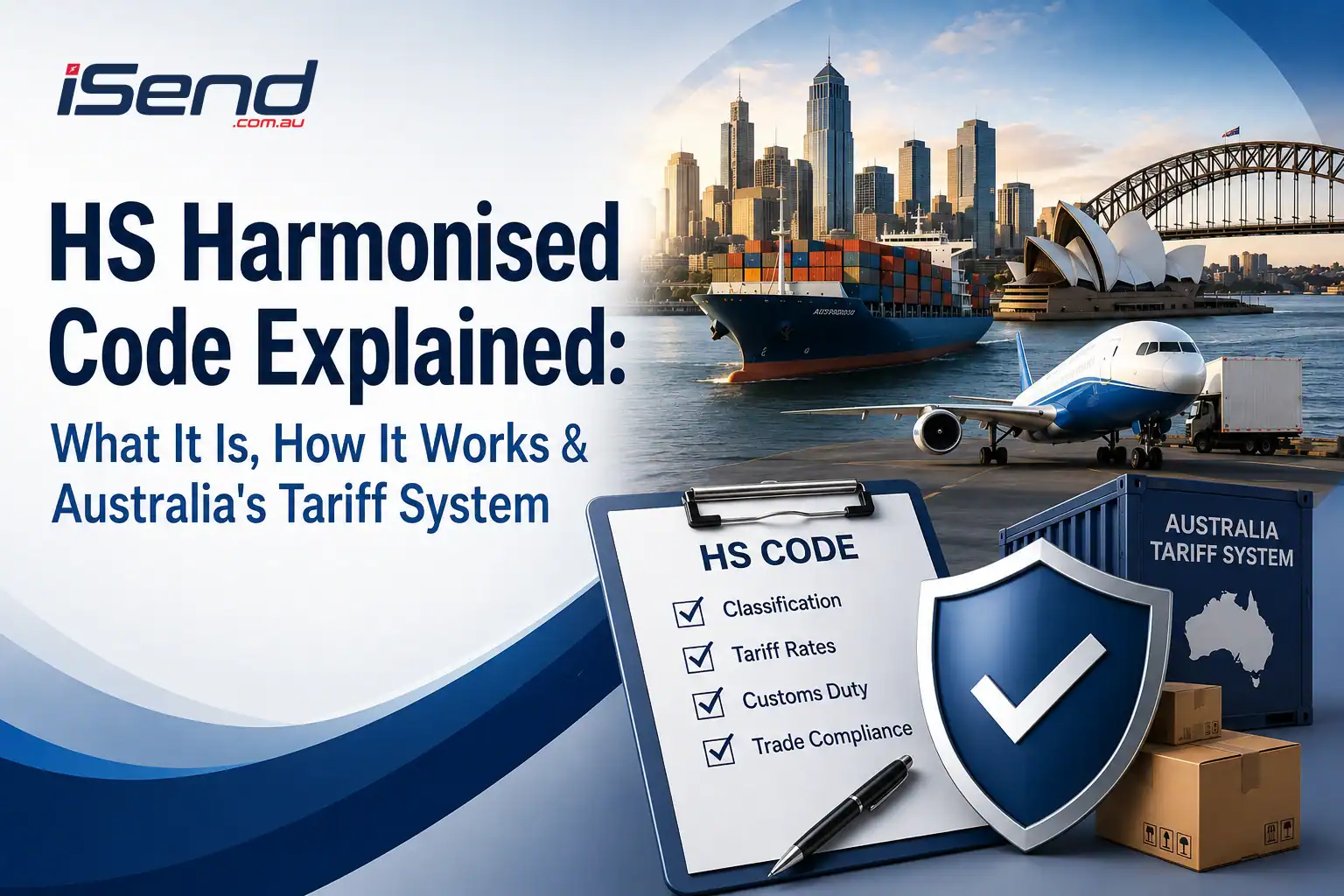
An HS code and tariff system is very important in international trade as it helps authorities to correctly classify products for export and import shipments. It is a standard numerical code. Getting this code right determines the tariff involved, the duty individuals pay, and how smoothly goods clear customs. If anything goes wrong with the HS harmonised code, delays and penalties are expected.
The system of HS codes is maintained by the World Customs Organisation (WCO). It covers 98% of the goods traded internationally.
How Is an HS Harmonised Code Structured?
The Harmonised System assigns 6-digit codes for goods.
| Digits | Represents | Example |
| 1-2 | Chapter (specific groupings within each section) | Crocheted apparel |
| 3-4 | Heading (narrow product type) | Trousers |
| 5-6 | Subheading (material details) | Linen |
| 7-8 | Australian-specific detail | Further national detail |
The code beyond 6 digits is HTS.
HS Code vs HTS Code: What’s the Difference?
The difference between HS code and HTS code should be well understood to avoid confusion. While the HS code deals with providing a global framework, the harmonised tariff code is specific to a country.
The first 6 digits are the same for the HTS code and the HS code. Countries add extra digits for specific classification in HTS codes. For instance, Australia uses an 8-digit HS code and HTS code.
| Basis | HS Code | HTS Code |
| Scope | International | Country-specific |
| Length | 6 digits | Ranges between 7 and 10. Australia has 8 digits |
| Authority | World Customs Organization (WCO) | By country-specific authority like the Australian Border Force in Australia. |
| Purpose | Used for international classification and trade statistics | Used for country’s import tariffs and trade data |
HS Tariff Code in Australia: How the System Works
The HS tariff code for Australia is in line with the global standards of the HS coding system. It was adopted through the Customs Tariff Act, 1995.
Before we move to the work, it is important to know the two types of codes used in Australia, namely:
- Australian Harmonised Export Commodity Classification, or AHECC, codes are used for exports.
- For imports, working tariff codes are used.
Working tariff
The working tariff is upheld by the Australian Border Force and essentially contains all the tariff classifications for goods entering the country. This is the document that specifies whether import restrictions are in place, what permits are required, the customs duties and other metrics related to importation.
AHECC
AHECC is similar in structure and hierarchy to the international HS system. The Australian Bureau of Statistics lists the codes for export commodities. As HS changes internationally, AHECC goes through minor changes, which are implemented by the Department of Home Affairs, Australian Border Force (ABF), and the ABS.
Australia’s Free Trade Agreements (FTAs) and HS Codes
FTAs are negotiated so that Australian exporters, importers, and producers benefit from the removal of certain trade barriers. Every free trade agreement has rules for specific HS codes and getting the right code for your product is important. Getting the wrong code could mean losing out on lower tariffs or even getting into legal trouble.
Authorities use the harmonised tariff code for a few key things: They determine whether a product qualifies, they determine the preferential tariff rate and duty concession. For example, if New Zealand and Australia have an FTA, a good imported from NZ could qualify for a lower tariff under the FTA. But only if the correct HS tariff code Australia classification is declared, which can be checked on the DFAT FTA Portal.
Australian Tariff Duty Rates
The tariff duty rates that apply to the goods are determined by the HS code and tariff agreements (like FTAs).
Australian tariff rates are mainly classified as:
- General rate: For most goods, the general rate is 5%
- Preferential rates: If the goods qualify under FTA, preferential rates are applied.
- China (ChAFTA): Most goods at 0% duty.
- South Korea (KAFTA) Most products 0%
- Duty-free If the value of imported products is AUD 1,000 or less they are exempt
HS Code and Tariff How Classification Affects Your Costs
Customs officials will look at the HS code you declare to determine where the product fits, what tariffs and taxes you owe and whether you need any special licenses or permits. They will also check if your products qualify for free trade agreements, and whether customs clearance can proceed without delay.
When the HS code matches the product, the whole process goes much more smoothly. Shipments clear faster, and there’s no hassle.
For example, a product classified as a toy could be subject to a substantially lower duty rate than if customs had listed it as electronic equipment. Because HS codes and tariffs are directly related, businesses need to classify products carefully.
How to Find Your HS Tariff Code in Australia
Here is a step-by-step process of how to find the HS code in Australia:
- Describe the product precisely: Mainly focus on answering what the product is, its material, its manufacturing process, and the use of the product.
- Search the ABF Working Tariff: ABF publishes the working tariff online. Go to the relevant section and chapter. Then look at headings and subheadings to narrow down the search.
- Apply the general rule of interpretation GRI: These are given by the WCO. The rules have to be applied in order. Usually, GRI 1 classifies most of the products; complex categories need GRI 2 and 3.
- Use the DFAT FTA Portal to check for FTA eligibility.
- If you are still confused, you can call the ABF Tariff Advice Hotline on 1800 053 016.
Common HS Code Mistakes — and How to Avoid Them
There are some common mistakes people make while determining the HS harmonised code:
- Vague classification: Suppose a smartwatch has features like heart rate monitoring, Bluetooth, and more. This might also be classified as a computing device and not just a timepiece. So, a detailed description should be considered.
- Not paying attention to material composition is another common mistake. Depending on the material used, a utensil may fall under HS 3924 (plastic), HS 7615 (aluminium) or HS 4419 (wood).
- Using import interchangeably for export codes (and vice versa).
- Copying supplier codes. The overseas supplier code is based on their country’s tariff schedule. These are different from Australia’s after the first 6 digits.
How AI Is Transforming HS Code Classification
AI is taking over the sphere of HS code classification, too. It reduces the time spent on the determination of HS codes from hours to minutes. Manual classification is plagued by the problem of human error and vague descriptions. But with AI tools, there is the highest accuracy combined with low effort.
The system can be adjusted such that it adapts to your internal company terminology and product history. Lastly, compliance confidence increases with the incorporation of AI. Australian platforms like DHL have also started benefiting from AI tools that use machine learning and predictive classification models.
Frequently Asked Questions About HS Harmonised Codes
Q: What is the HS tariff code in Australia?
It is a code used for the classification of goods. It adopts the international Harmonised System and extends the 6-digit code to 8 for local tariff and statistical purposes.
Q: Are HS codes and harmonised tariff codes the same thing?
HS code and HTS code are different. HS code is an international standard code for goods classification. HTS code is an extension of HS code adding country specific information.
Q: How do I find the correct HS code in Australia?
Australian Border Force tariff database of official codes. Make sure you consider the product description carefully to determine the code.
Q: What happens if I use the wrong HS code?
You end up with delays, penalties, and sometimes legal action taken against you. Also, free trade agreement benefits may be lost due to the wrong HS code.
Q: How often are HS codes updated?
The HS harmonised code is updated every five years.
Why HS Codes Matter for Bulk Shipping and eCommerce Businesses
For bulk shipping companies and eCommerce businesses, HS harmonised codes are far more important. The HS code affects shipping time, cost, and tariffs. This indirectly has an impact on the entire customer experience. Companies that don’t get it right risk additional customs fees and delays that can tarnish brand image. Similarly, there can be frequent product returns because of inaccurate HS codes. This negatively hampers the supply chain of e-commerce businesses.
Many modern logistics and shipping platforms now rely on AI-based HS code systems. At iSend, we deliver to more than 220 countries worldwide, including shipments to India. Our team ensures that the HS code is perfectly determined through AI tools so that you get a smooth delivery experience.
Conclusion
You can’t do international trade without the right commodity codes, like harmonised tariff codes. Get them wrong and you could lose a lot of money. That’s why it’s important who you trust with your shipments.
At iSend we know the ropes having delivered millions of packages internationally on time and safely. Let us handle yours. Book your shipment today!
Recent Posts


How to Handle Back Orders Without Wrecking Your Delivery Times
October 7, 2026

Top 7 Shipping Software for eCommerce Businesses in 2027
September 23, 2026

How to Reduce WooCommerce Shipping Costs in Australia
August 21, 2026