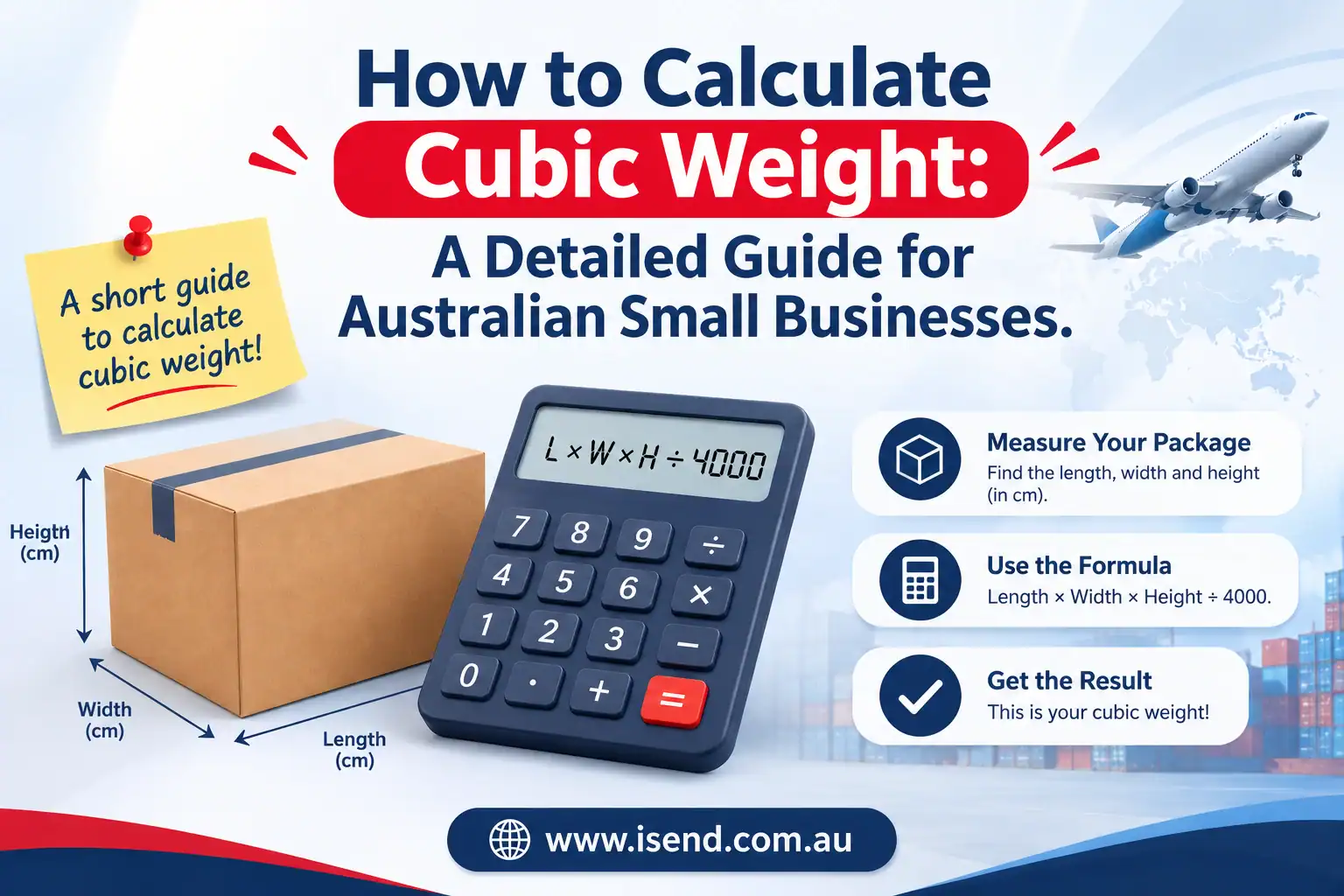
The Australian Bureau of Statistics reported that Australia’s online retail sales reached $4,703.8 million in June 2025. This has resulted in an increase in the number of packages being delivered by delivery services.Couriers consider the actual weight and size of a package, so a bigger package can cost more in shipping charges than a smaller but heavier package.
Australia Post uses a cubic weight ratio of 250kg per cubic meter for eligible parcels. Read more to learn about the calculation, how the cubic weight calculator works and ways to reduce your shipping costs.
What is Cubic Weight?
QUICK ANSWER
Cubic weight (volumetric weight) = Length (m) × Width (m) × Height (m) × Conversion Factor. In Australia, Australia Post uses 250 kg per cubic metre for eligible parcels. Couriers charge whichever is higher — cubic weight or actual weight — so a light but bulky parcel can cost more to ship than a small, heavy one.
Cubic weight, dimensional weight, or volumetric weight is a parcel’s equivalent weight. Couriers use it to account for the space a parcel occupies during delivery.
Actual weight is determined by weighing the parcel on a scale, while cubic weight relies on the parcel’s dimensions.
Cubic Weight vs. Actual (Dead) Weight
Actual, or dead, weight is the weight of the packed parcel, while cubic weight is the space it takes up for transportation. Here is a quick comparison between the two:
| Comparison | Actual Weight | Cubic Weight |
| Measurement | Physical weight | Parcel dimensions |
| Unit | Kilograms (kg) | Kilograms (kg) |
| Calculation | Weighing scale | Volume × conversion factor |
Cubic Weight, Cubed Weight and Volumetric Weight: Are They the Same?
Yes. Cubic weight, cubed weight, dimensional weight, and volumetric weight mean the same thing. The cubic volumetric calculator calculates the equivalent weight using the parcel’s dimensions and the carrier’s formula.
Why Do Couriers Charge by Cubic Weight?
Because transport vehicles have limited loading capacity, a bulky parcel can take up a lot of space even if it weighs little. For instance, a parcel with lightweight cushioning may take up more space than a parcel with metal parts. Thus, cubic weight matters when calculating freight charges.
How to Calculate Cubic Weight (Step by Step)
The most common formula uses the parcel’s dimensions and the carrier’s conversion factor.
Cubic Weight (kg) = Length (m) x Width (m) x Height (m) x Conversion Factor
Here are the steps:
- Measure the packed length, width, and height at the widest points, then convert each to metres (60 cm becomes 0.6 m).
- Multiply the three figures to find volume in cubic metres.
- Multiply the volume by the carrier’s conversion factor.
- Compare the result with scale weight.
For example, a parcel measuring 50 cm × 30 cm × 40 cm gives 0.5 × 0.3 × 0.4 = 0.06 m³, and 0.06 × 250 equals 15 kg. Converting to metres first prevents the classic error of multiplying centimetres and landing on a figure a million times too large. Any cubic weight calculator or spreadsheet follows these same steps.
Cubic Weight vs Actual Weight: Which Will You Be Charged?
Most Australian couriers calculate chargeable weight using the greater of actual or cubic weight. A 4 kg package with a cubic weight of 6 kg will typically be charged at the 6 kg rate. An 8 kg package that has a cubic weight of 3 kg will normally be charged based on its actual weight.
Australia Post operates under the same principle for domestic parcels where it applies, but prepaid and flat rate packaging is subject to separate pricing rules. Check the Australia Post parcel size and weight guidelines before making bookings.
Cubic Weight Factors by Carrier in Australia
Courier companies may use varying factors depending on their services and their freight contracts. Businesses should check the relevant carrier terms before calculating shipping costs.
| Carrier or freight category | Conversion factor |
| Australia Post | 250 kg/m³ |
| Aramex Australia | 250 kg/m³ |
| General freight (industry example) | 333 kg/m³ |
| International courier (industry example) | 200 kg/m³ |
| Air freight (industry example) | 164–167 kg/m³ |
How Cubic Weight Affects Australian Small Businesses
Cubic weight impacts shipping budgets, product prices and profits, especially for retailers of lightweight and oversized products. Larger packaging can increase chargeable weight and shipping costs.
Australians spent $82.6 billion online in 2025, a 14% increase on the previous year, according to Australia Post’s 2026 eCommerce Report. And 82% of Australian households have purchased goods online. Shipping estimation techniques play a crucial role in addressing the growing eCommerce market.
7 Ways to Reduce Cubic Weight and Cut Shipping Costs
Businesses can reduce package volume by using appropriate packaging methods without putting the product at risk. This pairs well with broader strategies to reduce WooCommerce shipping costs. These are some aspects to consider:
- Downsize containers: A box that is 10 cm oversized in all directions pays for nothing but air.
- Avoid packing with void filler: Choose the most appropriate container first, then pack only what will not fit.
- Use bags instead of boxes for soft goods: Soft materials tend to take up the form of whatever is being packed.
- Pack and bundle products: Compress cushions, roll posters, and stack bowls into each other.
- Use flat-packed items: Assembled products take several times the volume of the same flat-packed items.
- Build your pallets in squares: Packing products in squares at lower heights is often cheaper than packing in towers.
- Combine shipments: Shipping several containers together is cheaper than shipping the same cartons separately.
Calculating Cubic Weight at Scale
If businesses handle many daily orders, they need a reliable measurement method. Use a spreadsheet to track parcel dimensions, actual weight, packaging, and carrier conversion factors.
A cubic weight calculator helps packing teams ship parcels effectively. Businesses should measure sealed parcels using maximum external dimensions and update information after packaging changes. For cylinders, irregular packages, and filled satchels, measurements should cover the maximum length, width, and height.
Cubic Metres vs Cubic Weight (Don’t Mix Them Up)
The physical volume of a parcel is expressed in cubic meters (m³). Cubic weight converts a package’s volume into weight in kilograms.
For example, a package with volume 0.06 m³, with a conversion factor of 250 kg/m³, will have a cubic weight of 15 kg. Cubic calculators will provide the volume of the package and volumetric weight calculators will give you the cubic weight using the carrier’s factor.
FAQs
What is the cubic weight formula in Australia?
Length (m) × width (m) × height (m) × conversion factor gives cubic weight in kilograms. Australia Post uses 250 kg per cubic metre for applicable parcels and generally charges the higher of cubic and actual weight.
What is Australia Post’s cubic conversion factor?
Australia Post uses 250 kilograms per cubic metre for relevant domestic parcels. Multiply the parcel volume in metres by this number to get its cubic weight.
Is cubic weight the same as volumetric weight?
Yes, both terms describe the same calculation. Couriers also use dimensional weight and cubed weight to describe converting parcel volume into an equivalent weight for shipping charges.
Am I charged cubic or actual weight?
Most couriers in Australia charge the higher of the actual and cubic weight for services with volumetric pricing. The final calculation depends on the selected service, packaging rules and carrier terms.
How do I calculate cubic weight for irregular shapes or satchels?
Measure the maximum external length, width and height of the packed item. For cylinders, use the length and widest diameter for both width and height. Measure filled satchels at their fullest points.
Do all Australian couriers use 250?
No, 250 kg/m3 is the standard for domestic parcels but other cargo types and contracts with courier companies may have different values, e.g. 333 kg/m3. Always confirm the applicable service conditions.
How do I convert cm to cubic weight?
Divide each centimeter by 100, then multiply all three values by the courier’s conversion coefficient. For example, 50 × 40 × 30 cm equals 0.06 m³ of volume and 15 kg of cubic weight at 250.
Conclusion: Get Instant Multi-Carrier Quotes with iSend
Working out the cubic weight helps you control your delivery costs, choose the right packaging and compare courier rates.The cubic weight calculator makes your job easier and iSend lets you get quotes from different carriers in one interface.
Visit iSend for instant multi-carrier quotes, simpler parcel bookings, and cost-conscious shipping decisions.
Recent Posts



How to Handle Back Orders Without Wrecking Your Delivery Times
October 7, 2026

Top 7 Shipping Software for eCommerce Businesses in 2027
September 23, 2026