
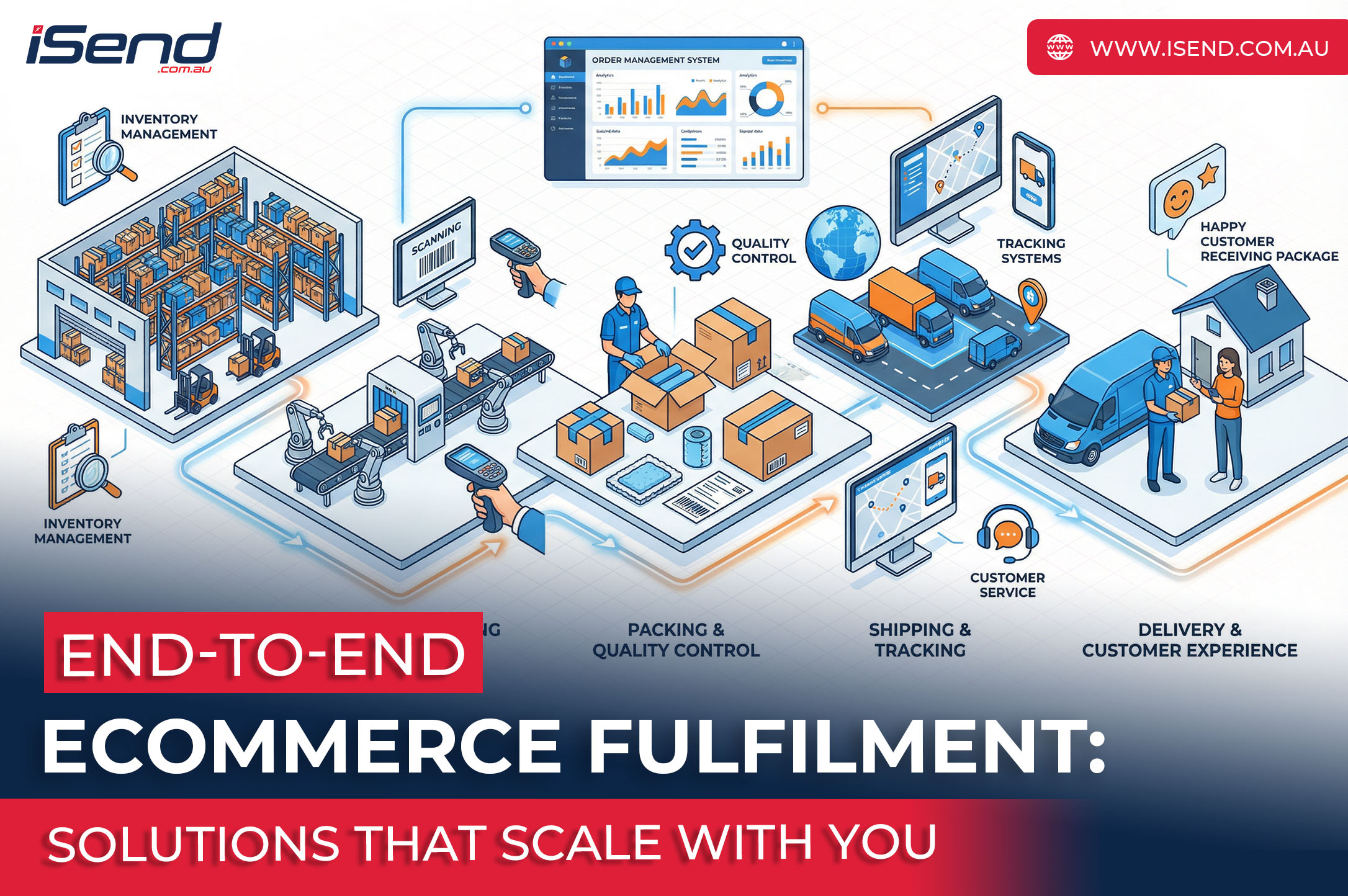
While selling online, your customers will never see your warehouse or workforce, but they experience fulfilment through touchpoints like delivery speed and quality of packaging. Knowledge of e-commerce fulfilment will help you manage these touchpoints, at the same time, keep the cost of operations under control.
With the increase in online shopping, fulfilment has gone beyond mere shipping of orders. Today, the e-commerce fulfilment includes stock storage, order processing, freight, delivery and returns.
With a powerful fulfilment strategy, the deliveries become quicker, the orders are taken accurately, and repeated purchases occur. With that foundation in place, let’s explore the key takeaways.
Key Takeaways
- E-commerce fulfilment is a complete operational system that connects inventory management, order processing, storage, shipping, and returns into one seamless workflow.
- When you optimise each stage of the e-commerce fulfilment process, you reduce errors, lower costs, and improve customer satisfaction.
- Choosing the right e-commerce fulfilment solutions depends on your order volume, available resources, and long-term growth plans.
- You can manage order fulfilment ecommerce operations in-house, outsource to a 3PL, or implement a hybrid model.
- Fulfilment directly impacts your brand reputation, delivery speed, and repeat purchase rates.
- Clear visibility across inventory management for ecommerce and shipping workflows helps you scale confidently.
Understanding Ecommerce Fulfilment for Online Businesses
E-commerce fulfilment involves everything that happens after the customer clicks the buy button. As an online seller, fulfilment defines the level of efficiency of purchases going from your warehouse to the doorstep of your customer.
Fulfilment becomes more complicated as your business expands. As the order volumes increase, channels of sale and customer expectations have to be managed through structured processes and dependable systems.
Rather than responding to fulfilment issues, it is possible to create workflows that sustain growth. This will automatically bring about a better understanding of e-commerce fulfilment’s meaning.
Meaning of Ecommerce Order Fulfilment
The e-commerce fulfilment process deals with the overall order cycle. Fulfilment ensures accuracy, speed, and reliability throughout the process from taking the order to delivering to the customer. It bridges the gap between the online stores and the movement of the products.
There are also behind-the-scenes activities in order fulfilment in e-commerce. These include inventory, warehouse and shipping partner coordination. Even the most effective marketing strategy can fail if it does not work in conjunction with these systems.
This is because when you consider e-commerce order fulfilment as an end-to-end process, it is easier to optimise. One step has an impact on the other, and that is the reason why step-by-step knowledge of how e-commerce fulfilment works is crucial.
How Ecommerce Fulfilment Works Step by Step
The process of e-commerce fulfilment is well organised to facilitate the movement of products. It begins with the receiving and storing of inventory, continues through order processing, and finally order delivery and handling of returns.
For you, this will involve establishing well-defined working processes and duties. Whether fulfilment is in-house or it is outsourced, you require insights into every step. Transparency of the processes will help you to keep track of customer experience.
In order to better understand this, let’s have a closer look at the end-to-end order processing journey.
The End-to-End Order Processing Journey
The order processing process enables the e-commerce to tie several fulfilment activities in a single cycle. It starts even prior to the actual order, and that is inventory planning and storage decisions. Once an order is received, the fulfilment process takes over the role.
All these steps in this process affect the speed of delivery, cost, and customer satisfaction. Even a small inefficiency can spread through the whole process. You can divide the journey into separate stages, as it will make it easier to see the opportunities for improvement.
We shall look at each of these steps, beginning with the inventory received from the suppliers.
Receiving Inventory from Suppliers
The receipt of inventory is the initial process of the e-commerce fulfilment. Upon arrival of products from the suppliers or manufacturers, they are checked for accuracy and quality. This makes sure that damaged or wrong products will not get into your fulfilment system.
Labelling and proper documentation at this stage help to avoid errors downstream. When inventory is done properly, e-commerce order processing becomes simpler. This provides a platform for the effectiveness of storage and fulfilment.
After the inventory receipt, it is transferred to the organised storage of the warehouse.
Storage and Warehouse Organisation
Warehouse organisation is very important as the storage of products is done in terms of size, demand, and frequency of picking. This arrangement saves the time spent on finding and packing items.
The warehouse is also organised to facilitate faster order fulfilment. Picking accuracy increases when your team or fulfilment partner has complete knowledge of the location of products. In the long run, this lowers the operating expenses and mistakes.
Effective storage will automatically lead to inventory tracking and stock control.
Inventory Tracking and Stock Control
The e-commerce inventory management will make sure that you are aware of the stock at all times. Live tracking avoids overselling and assists you in scheduling stock replenishment. Proper inventory information also helps in enhancing customer communication.
The stock control systems connect with your e-commerce site to automatically update stock status. It is this visibility that enables you to take informed decisions regarding promotions and demand forecasting. Delays in fulfilment are bound to occur unless it is tracked properly.
When the inventory is monitored properly, orders are effectively fulfilled.
Order Processing: Picking and Packing
Processing of e-commerce orders is done once the order is placed by a customer. The system produces a picking list, and the items are retrieved from the stores. At this point, precision is necessary to prevent returns and complaints.
Items are picked after that and packed using appropriate materials. Packaging helps in securing the goods during transportation, as well as it highlights your brand image. Picking and packing speed up the entire e-commerce fulfilment process.
The order is then transferred out of the warehouse and into the delivery network.
Shipping and Delivery to Customers
Shipping and fulfilment ecommerce activities are aimed at delivering orders to the customers on time. This includes selecting the carriers, creation of shipping labels and the distribution of packages. Speed of delivery is usually a significant factor in customer satisfaction.
The information tracking also helps in keeping the customers updated on the delivery process. This means that when you have visibility, support requests decrease and trust increases. The forward fulfilment cycle is completed by successful shipping.
But not all orders end in delivery, and this is where returns handling comes into play.
Returns Handling and Reverse Logistics
The returns handling and reverse logistics deal with returned products from customers. This involves checking on the returned goods, the restocking of the sellable goods and handling the refunds. Your customers are entitled to satisfactory products as per the consumer regulations.
Smooth reverse logistics is a safeguard to your margins as well. Reintegrating inventory fast helps you to save losses and to have better stock accuracy. The aspect of returns is a very important yet neglected area of e-commerce fulfilment.
Having covered the entire process, we are now going to discuss fulfilment solutions, which online retailers can make use of.
Fulfilment Solutions for Online Retailers
The fulfilment solutions offered by e-commerce brands depend on the size and the complexity of the business. Some retailers manage their own internal fulfilment, while others use external fulfilment agencies. Both alternatives have merits and demerits.
The selection of the appropriate solution will depend on your volume of orders, resources, and development strategies. These concepts of models will guide you to make fulfilment, and your business aligns together.
Let’s discuss the most common fulfilment strategies.
In-House Order Fulfilment
In-house order fulfilment implies that you do it yourself in terms of storage, packing, and shipping. This will give complete control over operations and branding. It is commonly used by small companies with order volumes that are manageable.
Nevertheless, in-house fulfilment involves investment in space, people, and technologies. Scaling can be a tricky thing as your business expands. This makes a lot of sellers resort to external support.
Third-Party Logistics (3PL) Services
Third-party logistics offer these storage and fulfilment services in e-commerce to your customers. They provide warehousing, order processing and shipping under the same roof. This will enable you to concentrate on sales and marketing.
The 3PL services are scalable and technology-based. They offer scalability without expensive infrastructure to businesses that have the potential to grow. This understanding allows one to understand why this option is different compared to other fulfilment models.
Hybrid Fulfilment Models
Hybrid fulfilment involves the integration of several approaches into a single approach. You can satisfy fast-moving items internally and outsource others to a 3PL. This method is a compromise between control and scalability.
Hybrid models are popular among businesses with a high rate of growth. They are not limiting as compared to sticking to a single approach. Having covered fulfilment options, it is necessary to discuss the common challenges.
Common Challenges in Online Order Fulfilment
- Inventory inaccuracies that lead to overselling, stockouts, or delayed ecommerce order processing.
- Rising shipping costs reduce profit margins and impact pricing strategies.
- Delayed shipments are caused by inefficient picking, packing, or carrier coordination.
- Lack of system integration between inventory management for e-commerce, order processing, and shipping tools.
- Limited real-time visibility into storage and fulfilment ecommerce operations.
- High return rates and inefficient reverse logistics processes increase operational costs.
- Difficulty scaling the e-commerce fulfilment process during seasonal demand spikes.
These challenges often intensify as your order volumes grow and operations become more complex. Addressing them requires streamlined workflows, accurate data, and technology-driven fulfilment solutions.
How iSend Simplifies Order Storage, Processing, and Shipping
iSend assists in the centralisation of e-commerce fulfilment in a single platform. You get the visibility of storage, order processing and shipping between various carriers. This eliminates manual efforts and errors in fulfilment.
Inventory management and shipping automation are also supported by iSend. With fulfilment workflows, you enhance customer experience and efficiency. In the case of expanding a business, this makes scaling easy without the complexity.
Frequently Asked Questions
What is the difference between fulfilment and 3PL?
Fulfilment can be defined as the storage, processing and shipping of the orders. A 3PL is a service provider engaged in fulfilment on your behalf. In simple terms, fulfilment is the service, and one of the ways to provide it is through a 3PL.
What Are the Best Fulfilment Solutions for Online Stores?
The most effective e-commerce fulfilment solutions require understanding business requirements. Small shops may prefer in-house fulfilment, whereas developing brands tend to select 3PL or hybrid ones.
How Does Order Processing Work After a Customer Places an Order?
When an order has been placed, it is received by the e-commerce order processing system. Products are selected, packed and delivered, and the customer is provided with the tracking details. This continues until the order delivery or return process is completed.
Conclusion
Online business fulfilment is an essential component of your e-commerce. It links the inventory control, order processing, storage, and shipping into a single integrated system. Optimised fulfilment enhances customer satisfaction and operational efficiency.
With the knowledge of how the e-commerce fulfilment works, you will be able to select the appropriate fulfilment solutions and scale with added confidence. If your business has high potential to grow, then partnering with a platform like iSend will be a better strategy.
Recent Posts
-

-
A Complete Guide to COGS Computation
February 12, 2026 -

Custom Duty India: Rules You Must Know Before Shipping to India
February 12, 2026 -
Import Tax Australia: A Complete Guide to Duties, GST & Fees (2026)
February 4, 2026 -

Kmart Return Policy Explained: Returns, Refunds & Key Rules
January 19, 2026