
If you run a Shopify store in Australia, you already know the pain. Orders come in. Inventory sits in one system. Couriers operate in another. Tracking updates lag. Customers flood your inbox asking, “Where’s my order?” Meanwhile, shipping costs quietly eat into your margins.
The e-commerce market of Australia is on the rise; it is expected that by 2032, this market will grow to $9 trillion. However, as more than 75% of the Australian shoppers anticipate quick and low-cost shipping, shipping is no longer an operational bonus, but a driver of growth. This is why it is not just a tech decision to find the appropriate Shopify shipping integration. It is a strategic move.
Be it in the case of getting a scalable Shopify 3PL or getting a comparison of who provides eCommerce fulfilment in Australia, the shipping layer needs to be intelligent, automated, and future-proof. Before you commit to a Shopify fulfilment partner, here are the seven must-have features your integration should deliver.
Benefits of Shipping with Shopify
Direct shipping in Shopify has changed significantly. It provides a great deal more than mere label printing today. This is the reason brands are turning to sophisticated shipping options:
1. Centralised Operations
Orders, inventory, tracking, and returns are hosted in a single ecosystem with adequate seamless API integration for Shopify. This eradicates manual data transfers of information between systems and minimises human error greatly. The real-time synchronisation keeps the stock levels, shipments and customer notifications updated. In the case of expanding brands, this centralisation enhances efficiency and allows teams to concentrate on strategy rather than urgent operations.
2. Access to Carrier Networks
Shopify links vendors to key worldwide shippers, providing companies with the freedom and competitive price choices. In the case of Australian brands, this consists of easy access to Australia Post, DHL, UPS, and FedEx in domestic as well as international deliveries. Multiple carrier choices enhance the speed of delivery and optimise the cost. It also enhances the cross-border competencies with an increase in the number of Australian companies entering international markets.
3. Faster Order Processing
Auto workflow and bulk label printing dramatically lower the dispatch times, particularly during peak sales. It is possible to filter, process and fulfil orders within minutes rather than hours. This velocity is essential because same-day and next-day delivery demands are steadily escalating in the whole of Australia. Speed of processing is not only beneficial for the performance of operations but also increases customer satisfaction.
4. Expanding Internationally
The market of websites in cross-border eCommerce in Australia is expanding, and Shopify makes international shipping easier with built-in solutions. At checkout, merchants are able to calculate duties and taxes and create documentation on customs. This minimises the time wastage at the borders and avoids surprises for the customers. Shopify allows scaling brands to globalise with ease by making compliance and paperwork less complex.
5. Better Customer Experience
Customers are updated on the status of their package between dispatch and delivery on branded tracking pages and regular notifications. Businesses can retain a uniform brand experience as opposed to sending buyers to third-party carrier websites. Timely communication eliminates the “Where is my order?” questions and establishes trust. In the long term, such transparency will enhance customer satisfaction, loyalty and repeat purchase rates.
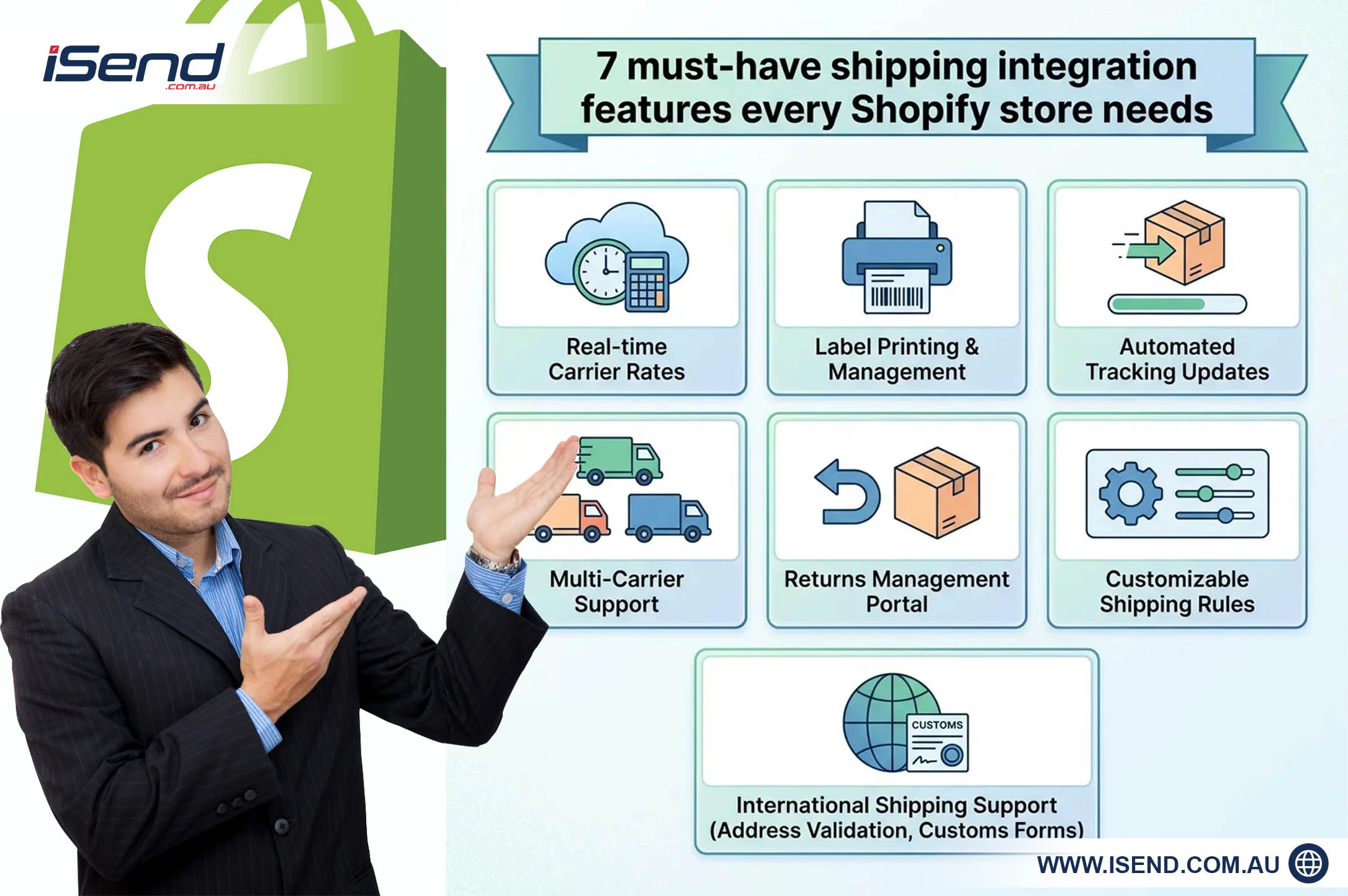
7 Must-Have Features in a Shopify Shipping Integration
Simple shipping tools do not last long as your store expands. Your Shopify shipping integration should have the following fundamentals of scaling efficiently and competing in the fast-paced Australian eCommerce environment.
1. Real-Time Order Sync & Automation
Your integration should offer real-time syncing of orders between Shopify and your warehouse or 3PL provider.
Why?
Due to delays during the syncing process, there is a fulfilment error, overselling, and a shipping backlog. The most effective systems have AI-powered fulfilment automation that allows them to:
- Automatically dispatch orders to the closest warehouse
- Assign optimal packaging
- Activate pick-and-pack processes immediately
- Reduce manual intervention
A survey by Deloitte found that 58% of organisations noted an improvement in employee satisfaction due to automation, as routine tasks are offloaded, allowing staff to focus on more strategic initiatives. A well-developed seamless API integration for Shopify will make sure that all orders update the inventory in real-time, on all sales channels. When your shipper demands CSV files or manual feeds, then that is a warning.
Automation cannot be compromised for companies that want to consider scalable e-commerce fulfilment in Australia. In addition to efficiency, real-time automation enhances the delivery accuracy and boosts customer trust. It also allows companies to scale more order volumes without necessarily increasing staffing or the complexity of operations.
2. Real-Time Carrier Rate Shopping at Checkout
The most common cause of cart abandonment in the world is shipping costs. Your Shopify shipping service should support:
- Comparisons of live rates among carriers
- Smart rule-based pricing
- Optimisation based on the location
- Logic of weight and dimensional rate
Dynamic shipping rates: Shopify allows customers to view the correct prices at checkout time with no surprises. State-of-the-art integrations also enable companies to:
- Express and standard options are available
- Show approximate delivery times
- Maximise per-postcode margins
Unless your Shopify fulfilment vendor is able to deliver real-time rate shopping, you may be losing conversions per day. Proper rate visibility not only increases the rate of checkout but also safeguards your margins against undercharging. It is a way of providing transparency in pricing as well as ensuring profitability in operations.
3. Automated Tracking & Branded Post-Purchase UX
Shipping does not stop at dispatch; this is the start of your after-sales experience. An efficient Shopify shipping integration ought to:
- Auto update tracking information
- Offer branded tracking portals
- SMS and email notifications are on
- Help with proactive delivery notifications
Why does this matter?
Since it is less expensive than acquisition due to the low cost of post-purchase customer retention. The Harvard Business Review has famously reported that increasing customer retention rates by just 5% can increase profits by 25%-95%.
Rather than sending customers out to carrier sites, branded portals retain traffic in your ecosystem. You can:
- Cross-sell products
- Share discount codes
- Reinforce brand messaging
In the case of the Australian brands expanding with the help of eCommerce fulfilment Australia, the presence of the post-purchase visibility will create long-term trust, particularly in the cases of both rural and interstate delivery. Frequent communication decreases the anxiety of the customer and minimises the number of support tickets greatly. It changes shipping into a brand-building experience as opposed to transactional.
4. Multi-Carrier Support & Global Scalability
The logistics environment in Australia is complicated. Shipment to Sydney to Perth is completely different to shipment to Brisbane and Melbourne. Multi-carrier flexibility is important for this reason.
Your Shopify shipping integration is supposed to support:
- Australia Post
- DHL Express
- UPS
- FedEx
- Regional couriers
The best multi-carrier shipping apps for Shopify Australia enable automatic carrier selection based on:
- Delivery speed
- Cost
- Zone
- Parcel size
Australia exporting internationally, particularly to the Asia-Pacific, is also increasing; therefore, your integration should also be able to support international documentation and DDP (Delivered Duty Paid) choices. When the Shopify fulfilment partner has fewer carrier options, then scalability is limited.
This is also due to carrier diversification, which gives options for backup in times of peak seasons or service disruption. This scalability helps ensure the performance of the delivery and defends your brand.
5. Integrated Returns & Exchange Management Portal
Returns are inevitable. Unless appropriately integrated, returns cause havoc. A contemporary Shopify shipping integration should provide:
- Self-service return portals
- Automated label generation
- Options for exchanging and storing credit
- On-demand out-of-stock re-orderings
Automated reverse logistics comes in at this point.
You can, instead of refunding revenue:
- Encourage exchanges
- Issue instant store credit
- Track return analytics
In the case of a brand that relies on 3PL for Shopify, built-in returns eliminate the operational hiccups and maintain the margins. The reverse logistics is smart, which enhances efficiency and customer satisfaction, particularly in the geographically wide delivery areas of Australia.
An efficient returns policy also enhances confidence in buyers at checkout. Customers tend to make a purchase when they are aware that they can easily make a purchase back.
6. Eco-Friendly Shipping & Carbon Offset Options
The consumers of Australia are becoming green. Consumers are willing to spend an average of 9.7% more on sustainably produced or sourced goods, even as cost-of-living and inflationary concerns weigh.
Your Shopify shipping integration would need to support:
- Carbon-neutral shipping
- Emission tracking
- Optimisation of environmentally-friendly packaging
- Contributions are made towards carbon offsets
This is in line with the increasing need for sustainable e-commerce logistics.
Provision of green shipping at the checkout:
- Enhances brand perception
- Gen Z and Millennial appeals
- Differentiate your business
Sustainability is no longer a choice, but a competitive edge to Australian brands destined to produce their products on a global level. Green programs also have the ability to enhance branding and shareholder attraction. Sustainable supply chain logistics are becoming more and more effective in determining buying behaviour and loyalty in the long term.
7. Deep Inventory Sync & Omnichannel Connectivity
There is no better way of harming customer trust than by overselling. A potent Shopify inventory management shipping integration guarantees:
- Real-time stock sync
- Multi-warehouse visibility
- Alignment of omnichannel sales
- Automation of stock forecasting
When you sell through Shopify, Amazon, marketplaces or retail, your inventory should be updated immediately in systems. Inventory and shipping information integrates directly with your fulfilment centre through seamless API integration with Shopify.
This especially matters when the brand is employing e-commerce fulfilment in Australia, whereby the same warehouse can be used in various regions. Close inventory connectivity can also be used in intelligent demand planning and regional stock allocation. This optimises the execution of delivery to the customer and reduces unnecessary storage expenses.
Why iSEND Shopify Shipping Integration Matters for Brands
Technology is all when it comes to the assessment of a Shopify fulfilment partner. iSEND provides an effective Shopify shipping solution to Australian-based scaling brands. iSEND has advanced automation, real-time tracking, and scalable eCommerce fulfilment Australia infrastructure to the businesses interested in reliable and tech-enabled 3PLs to find solutions to their Shopify applications.
Our Shopify API seamlessly combines operations so that there is real-time integration of orders, inventory and shipping information and therefore, eliminates manual operation and expensive misinformation. To those brands that focus on automation, multi-carrier flexibility, and operational efficiency, iSEND offers a performance-based fulfilment system that fits the current requirements of eCommerce expansion.
Conclusion
Today, shipping is not only logistics, but defines customer experience, brand loyalty, and profitability. Prior to selecting a Shopify fulfilment business partner, verify that your Shopify shipping extension contains AI-based automation, dynamic shipping rates, branded tracking, multi-carrier adaptability, automated reverse logistics, eco-friendly e-commerce logistics, and potent Shopify inventory administration shipping integration.
iSEND can help Shopify brands that are prepared to scale with a robust, tech-powered Shopify 3PL with seamless Shopify API integration and advanced solutions to eCommerce fulfilment in Australia. With the Australian eCommerce market expanding, the successful brands will provide speed, transparency, and reliability on a large scale.
Recent Posts
-

-
-

-

What Is Ecommerce Fulfilment & How It Works
March 3, 2026 -

A Complete Guide to COGS Computation
February 12, 2026