
isend

3PL vs 4PL: Key Differences Explained (2025 Guide)
3PL vs 4PL

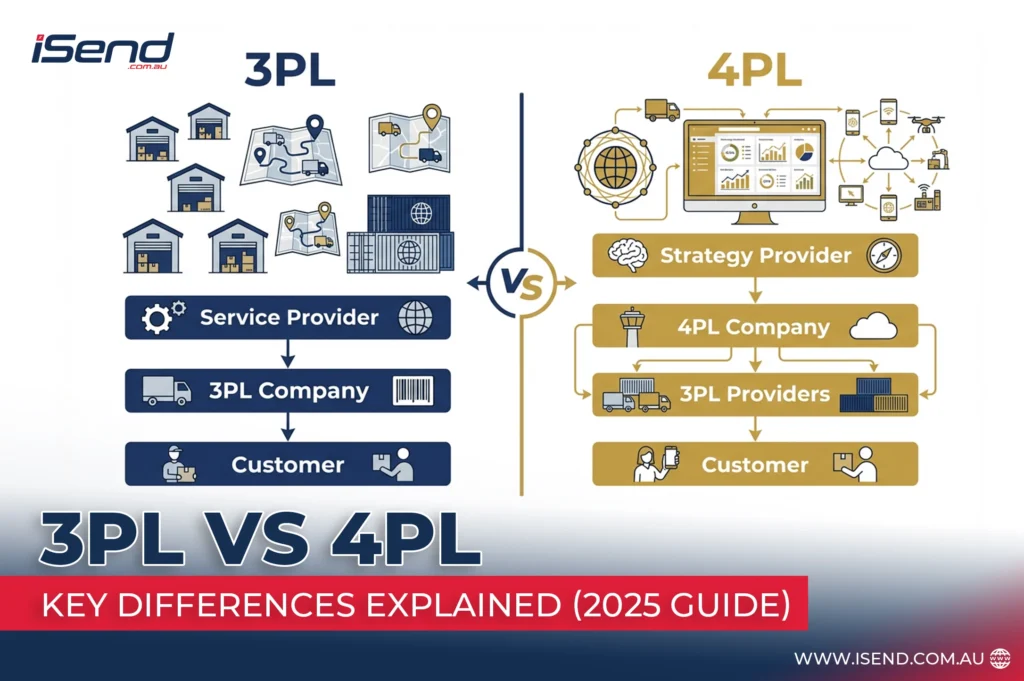
As the business grows, many companies use external partners to manage their warehouses, transportation, and fulfillment. This is a fundamental reason why understanding 3PLvs. 4PL models is crucial today. In Australia, the logistics outsourcing market continues to grow, with the 3PL sector predicted to grow by USD 44.32 billion by 2033, with a CAGR from 2025 at an increase of 7.04% in 2025. This rise in demand highlights the importance of outsourced logistics to modern supply chains when evaluating 4PLvs 3PL options. What is 3PL? (Third-Party Logistics Explained) It refers to the outsourcing of the logistics operations to a specialized external provider. These suppliers handle operational components such as order fulfillment, stock management, packaging, picking, warehousing, and transportation. Most 3PLs operate dedicated fulfillment centers equipped with a Warehouse Management System (WMS), barcode scanning equipment, automated sorting belts, and carrier integrations with other companies, such as DHL, FedEx, and Australia Post. The 3PLs enable companies to save on storage expenses, enhance delivery speed, and have real-time supply chain visibility. Who should use 3PL? E-commerce businesses, manufacturers, and retailers utilize 3PL services to enhance their operational efficiency and concentrate on core business activities. The features of 3PL providers: ● Manage distribution, warehousing and shipping ● Provide freight forwarding and clearance ● offer inventory control applications (real-time stock, prediction) ● Automate pick-pack to make order fulfillment services possible ● integrate e-commerce networks with the marketplaces like Shopify, Amazon, eBay,  WooCommerce, and many more. What is 4PL? (Fourth-Party Logistics Explained) A Lead Logistics Provider (LLP), or fourth-party logistics (4PL), is an extension of the operational practice of 3PLs. A 4PL is a supply chain partner that manages all logistics ecosystem components and coordinates them. It manages end-to-end planning, technology, vendor relationships, and multi-3PL functions. It acts as a single point of contact for the business. This makes 4PL suitable for an organization where complete supply chain control and long-term optimization are required. When do businesses choose 4PL? It provides a comprehensive solution: Strategic Planning: To design an optimized logistics strategy, a 4PL analyzes demand patterns, supplier performance, transportation costs, and warehouse productivity. This involves network redesign, vendor selection, route planning, forecasting, and performance benchmarking to increase responsiveness and cost savings. Logistics Coordination: 4PLs utilize AI forecasting, TMS, WMS, IoT tracking, and control towers to centralize data, automate workflows, optimize routes, and provide real-time visibility. This minimizes delays, reduces errors, improves inventory accuracy, and increases end-to-end supply chain efficiency. Technology Integration: 4PLs utilize advanced tools, including AI forecasting, TMS, WMS, IoT tracking, and supply chain control towers. These integrated systems combine data, automate operations, and reduce errors. Advanced Support: It provides: A 4PL becomes the single accountable entity for strategy, planning, technology, vendor management, and ongoing enhancement to provide a single, data-driven supply chain solution. ​3PL vs 4PL: Detailed Comparison Here are the details: Scope and Service Responsibility When evaluating the 4PL vs 3PL, the primary distinction lies in the scope of their services. A 3PL has operations in transportation, warehousing, inventory, and order fulfillment. They manage specific tasks within a company’s supply chain. But a 4PL maintains the entire logistics system. It collaborates with multiple 3PLs, carriers, and vendors to design supply chain strategies, optimize networks, and enhance end-to-end performance. This position calls the 4PL a strategic partner rather than an executor. Asset ownership (3PL vs 4PL) A significant 3pl vs 4pl difference is asset ownership. 3PLs often operate their own warehouses, vehicles, and fulfillment infrastructure, allowing companies direct access to existing logistics assets. 4PLs are usually non-assetless. Instead of owning trucks or facilities, they coordinate and manage assets across several logistics providers. This neutrality allows for greater flexibility, cost optimization, and a fair selection of vendors. Communication and Client Relationship In the 4PL vs. 3PL model, the communication style shifts from transactional to strategic. The 3PL relationships are tactical – clients interact with the 3PL and its staff for timely information, warehouse coordination, or daily operational needs. 4PLs serve as a single point of contact for all supply chain activities. They connect, manage partners, provide predictive insights, integrate technology, and offer performance dashboards. The relationship is collaborative and long-term. Use case suitability: Which logistics model fits your business? Here is 3PL vs 4PL explained based on suitability: A 3PL would be appropriate in cases where you require the effectiveness of execution, faster delivery, improved warehousing, or reliable shipping. This is ideal for small to mid-sized companies or brands that prioritize operational efficiency. A 4PL is suitable for companies with a complex network of multiple vendors that require a high level of visibility, strategic planning, sophisticated analytics using AI, TMS, predictive tools, and international coordination. It is appropriate for businesses that want to optimise their supply chain, scale up, and have centralised control. Comparison Table: 3PL Logistics vs 4PL Logistics Companies can make informed decisions by acknowledging the 3PL vs 4PL differences. ​ Feature 3PL Logistics 4PL Logistics Primary Focus Execution of specific logistics tasks like warehousing, transportation, and fulfillment Strategic oversight and management of the entire supply chain Scope of Service Handles individual segments or tasks within the supply chain Manages end-to-end supply chain, often integrating multiple 3PLs and carriers Asset Ownership Often owns physical assets such as warehouses, trucks, and equipment Typically non-asset based; manages assets of 3PLs and other providers Client Relationship Transactional or tactical service provider Strategic partner and single point of accountability Level of Control Client retains significant strategic control over logistics operations Client delegates most operational control to the 4PL Technology Use Operational tools like WMS, inventory tracking, and shipping software Advanced integration: AI, predictive analytics, TMS, WMS, IoT, and supply chain control towers Key Objective Cost reduction, operational efficiency, and faster fulfillment Supply chain optimization, strategic alignment, and long-term value creation Point of Contact Client may manage multiple vendors or 3PLs Single point of contact for all supply chain operations Best For Small to mid-sized businesses, e-commerce, retail, and straightforward logistics needs Large enterprises, global supply chains, multi-vendor networks, and complex operations ​Pros & Cons of

What is 3PL Logistics? A Complete Guide for Australian Businesses

Third Party Logistics

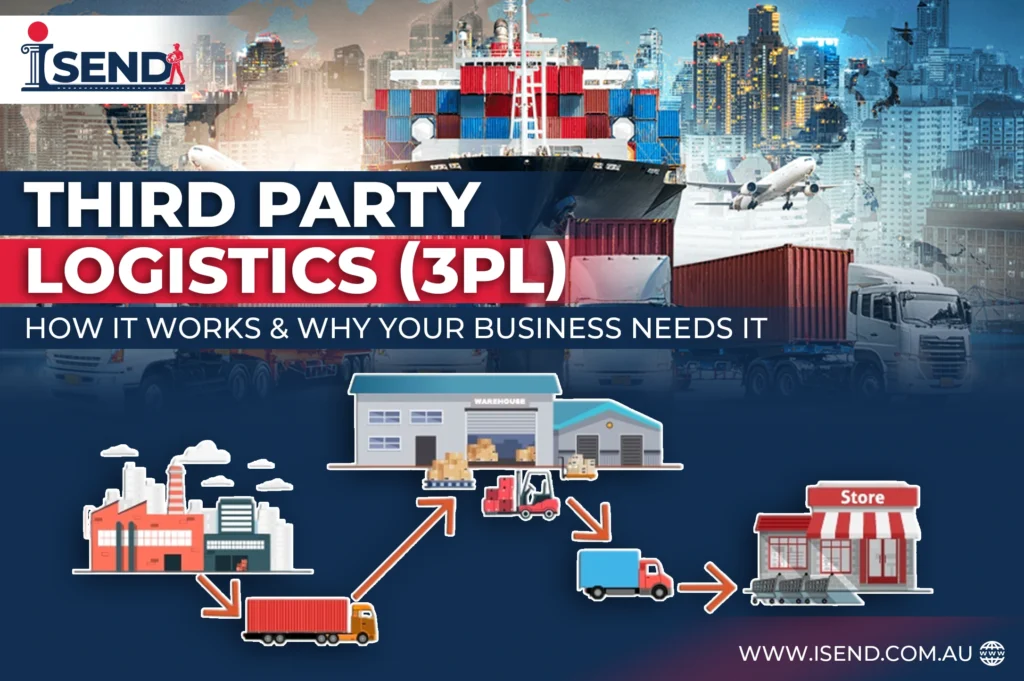
Introduction  Struggling with rising logistics expenses and ongoing supply chain headaches? In Australia, almost 63% of firms outsource logistics to third parties to gain greater freedom and less risk. It allows access to rich logistics expertise, advanced systems, and broader networks, streamlining operations and reducing expenses. 3PL speeds up delivery and customer satisfaction and enables incorporating innovation and growth in transit processes. In a market where operational agility defines competitive advantage, a logistics firm’s expertise, technology, and networks can help businesses save money, boost productivity, and grow quickly.  Understanding what is third party logistics lays the foundation for a resilient supply chain.  This article offers a detailed explanation of third-party logistics and how Australian companies can benefit from it. So, let us begin! What is 3PL Logistics? A 3PL logistics company is a company that provides outsourced logistics services to companies. Essentially, it is an outside partner that handles and performs some of the functions of your supply chain on your behalf. Instead of owning and operating your own warehouses, leasing a fleet of trucks, and employing a vast number of logistics personnel, you can use the equipment and services of 3rd party logistics companies.  The 3 PL model is very commonly prevalent today. A report estimates that the Australian 3PL Market is expected to reach USD 14.34 billion in 2025 and grow at a CAGR of 4.64% to reach USD 17.98 billion by 2030. The growth is fueled by the wide spread of 3PL services as companies tend to make their businesses more efficient. What Does a Third-Party Logistics Provider Provide? Third-party logistics companies provide services for managing product’s lifespan, from storage to dispatching. These services can be customised according to a firm’s requirements, and the extent of the services may be broad or specific. Warehousing and Storage Storage and warehousing are the most fundamental services third-party logistics provider offers. They have massive, strategically located warehouses where all types of merchandise can be stocked. This is economical for organisations as they do not have to spend on expensive real estate, maintenance charges, and electricity payments. If you are looking for 3PL Melbourne or 3PL logistics in Sydney, these organisations offer a chain of buildings so that you can supply your customers more directly. For deeper insights, you can explore warehouse logistics practices and challenges. Inventory Management A successful business largely depends on adequate inventory management. 3rd party logistics providers use advanced Warehouse Management Systems (WMS) to track real-time inventory levels. This ensures accurate stock levels, avoids overstock and stockout, and provides visibility of existing stock. Such technology is a significant advantage as it is usually too costly for small and medium businesses to develop independently. Order Fulfilment (Picking, Packing, Shipping) Order fulfilment is key to third-party logistics success (3PL). After an order is placed, the warehouse personnel “pick” the product off the shelf, “pack” it safely with appropriate protection, and “ship” it to the buyer. This efficient process is highly effective and can reduce the time it takes for a customer to receive their order by a wide margin. Amazon is a prime example of this; while not necessarily a pure 3PL, it has still been able to establish a robust fulfilment network. Learn more about order fulfilment and why it is crucial for e-commerce businesses. Transportation and Distribution A 3PL logistics provider is in charge of making deals with different carriers. From that, they can negotiate the best shipping rates for the customers and handle all the transportation work. It is not only that; the same company covers shipping the goods to the client from the port. The ability to leverage an existing network of carriers means businesses do not have to worry about the complexities of shipping logistics. Returns Management Also referred to as reverse logistics, returns management is a key operation for e-commerce companies. A renowned company offering 3PL Logistics in Australia can handle returns systematically. Such companies handle every aspect of return logistics starting from product procurement to inspection, stocking up, refurbishing, or disposing. This ensures a professional and smooth process for the consumer, which is crucial in establishing brand loyalty. Technology & Integration Support Technology is powering 3rd party logistics services these days. Third-party vendors integrate a web store with Shopify, Magento, and WooCommerce. The process is easier and transparent as all this is performed with real-time inventory levels, auto-synching orders, and tracking details as part of the seamless data flow. Benefits of Using 3PL Logistics Many ask what is a third party logistics provider and why should they outsource logistics. There are several compelling reasons why Australian businesses are turning to 3PL logistics services. These include: Cost Savings Outsourcing the logistics part of the business completely avoids capital investment in warehouses, vehicles, and technology. The process will also cut down operational costs through the 3PL’s negotiated shipping rates and the utilisation of its economies of scale. Scalability A 3PL Melbourne provider can effortlessly expand or reduce operations to fit your business requirements. This tool is handy during a seasonal business or sales period, such as Christmas, when the number of orders rises quickly, causing overstocking. With the help of a 3PL logistics in Brisbane provider, businesses, particularly online ones, can focus on scaling up their other core operations instead of worrying about management, shipping, exchanges, returns, etc. Access to Expertise The logistics industry is dynamic and intricate. Engage with a specialist third-party logistics team, and you will have a team of industry professionals who can optimise your supply chain, reduce mistakes, and make your business more efficient.  A leading third party logistics provider has insider knowledge about transportation, import and export, documentation, international compliance, economic policies and regulations, and other complications. They can handle cost delays and goods entry in a new region and reduce the cycle time when introducing a business across border markets. Improved Customer Experience Quicker and more precise shipping and a professional returns process lead to customer delight. A study revealed that 3PL third party logistics accounts for