
3PL vs 4PL: The Complete Guide for Australian Businesses
Everything you need to know about Third-Party Logistics and Fourth-Party Logistics — what they do, how they differ, what they cost, and which model fits your business right now.
As your business grows, managing warehouses, transportation, and fulfilment in-house becomes expensive and time-consuming. That is why understanding the difference between 3PL and 4PL is one of the most important logistics decisions you will make. Choose the wrong model and you pay for capabilities you do not need — or worse, you outgrow your provider just as demand accelerates.
This guide cuts through the jargon. Whether you run an Australian e-commerce brand, a manufacturer, or a fast-growing retail operation, you will find a clear, practical answer here.
What is 3PL? (Third-Party Logistics Explained)
A Third-Party Logistics provider (3PL) is an external company you hire to handle the physical operations of your supply chain. Instead of managing your own warehouse and fleet, you outsource those functions to a specialist that already has the infrastructure, technology, and expertise in place.
Most 3PLs operate dedicated fulfilment centres equipped with Warehouse Management Systems (WMS), barcode scanning, automated sorting, and direct carrier integrations with providers like Australia Post, StarTrack, DHL, FedEx, and Toll. This means your customers get faster, more reliable deliveries — without you having to build or lease a single shelf.
Core Functions of a 3PL
- Warehousing & Storage: Receiving, put-away, and storage of your inventory in shared or dedicated facilities
- Order Fulfilment: Picking, packing, and dispatching customer orders accurately and on time
- Transportation Management: Coordinating inbound and outbound freight across carriers
- Inventory Management: Real-time stock visibility, forecasting, and replenishment alerts
- Returns Processing: Managing reverse logistics and restocking returned goods
- Freight Forwarding: Handling import/export documentation and customs clearance
- E-commerce Integration: Direct connections to Shopify, WooCommerce, Amazon, eBay, and other platforms
Who Should Use a 3PL?
A 3PL is the right choice for small to mid-sized Australian businesses — e-commerce brands, retailers, and manufacturers — that want to outsource the execution of logistics without surrendering strategic control. It is also ideal for businesses experiencing rapid growth or seasonal spikes that would be costly to manage in-house.
What is 4PL? (Fourth-Party Logistics Explained)
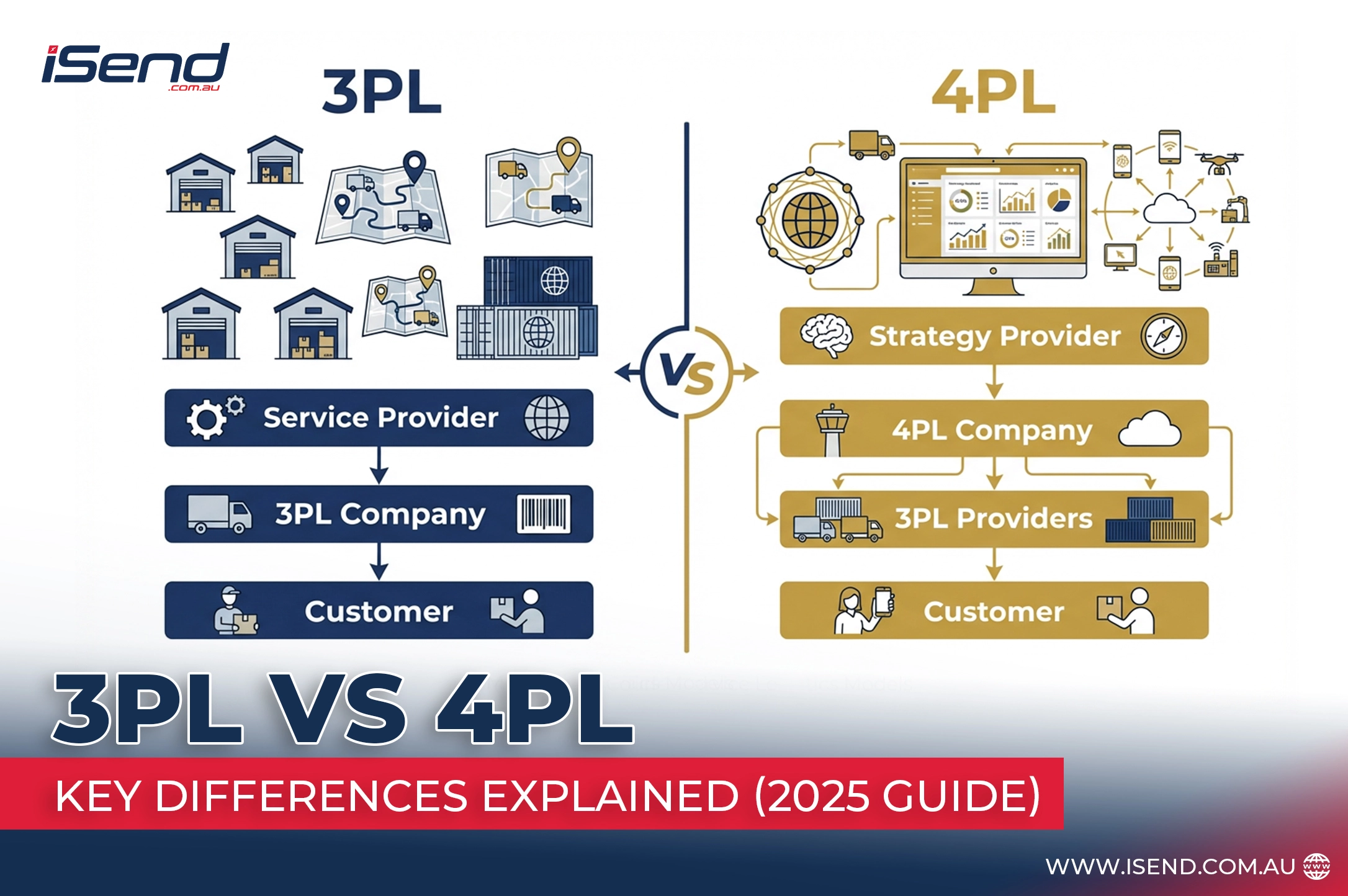
A Fourth-Party Logistics provider (4PL) — also called a Lead Logistics Provider (LLP) — does not execute physical logistics. Instead, it acts as the architect and manager of your entire supply chain. A 4PL designs your logistics strategy, selects and manages multiple 3PLs and carriers on your behalf, and integrates all the technology to give you a single, unified view.
Think of it this way: if a 3PL is the hands of your supply chain, a 4PL is the brain. It orchestrates every provider so that your goods move efficiently from suppliers to customers — regardless of how many regions, carriers, or fulfilment centres are involved.
The term was first coined by Accenture in 1996 as “an integrator that assembles the resources, capabilities, and technology of its own organisation and others to design, build, and run comprehensive supply chain solutions.” Today, 4PL has evolved into what Gartner calls a “new 4PL” — a holistic supply chain control tower with capabilities spanning logistics, demand planning, inventory management, and supply management.
Core Functions of a 4PL
- Supply Chain Design: Network mapping, warehouse location strategy, and product flow optimisation
- Vendor Management: Sourcing, contracting, and overseeing all 3PLs, carriers, and freight companies
- Technology Integration: Connecting WMS, TMS, ERP, and IoT platforms into a unified control tower
- AI & Predictive Analytics: Demand forecasting, route optimisation, and inventory positioning
- Performance Monitoring: KPI dashboards, real-time alerts, and continuous improvement reporting
- Risk Management: Contingency planning for carrier failures, geopolitical disruptions, or natural disasters
- Global Compliance: Multi-country customs coordination, regulatory management, and import/export support
Who Should Use a 4PL?
A 4PL suits large enterprises or fast-scaling businesses with complex, multi-vendor, or international supply chains. If you are currently managing multiple 3PLs without a unified view, or your team is overwhelmed by logistics administration, a 4PL can transform your operations.
How the 3PL Process Works (Step-by-Step)
Understanding the fulfilment workflow helps you evaluate whether a 3PL can meet your service-level needs.
How the 4PL Process Works (Step-by-Step)
3PL vs 4PL: Key Differences Explained
3PL
- Executes physical logistics tasks
- Owns warehouses, vehicles, and equipment
- Manages a segment of your supply chain
- Transactional / tactical relationship
- Client retains strategic control
- Variable, usage-based pricing
- Best for SMBs and e-commerce
4PL
- Manages and optimises the entire supply chain
- Non-asset based — coordinates others’ assets
- Manages the whole logistics ecosystem
- Strategic, long-term partnership
- Client delegates operational control
- Fixed management fees + performance incentives
- Best for large enterprises and global operations
Scope & Service Responsibility
The most fundamental difference is scope. A 3PL manages specific tasks within your supply chain — think warehousing in Sydney or freight from Melbourne. A 4PL manages the entire logistics ecosystem: multiple 3PLs, carriers, vendors, and the technology connecting them all. This shifts the 4PL from a service provider to a strategic partner.
Asset Ownership
3PLs are asset-based: they own or lease the warehouses, forklifts, trucks, and fulfilment infrastructure you use. 4PLs are typically non-asset-based: their value lies in strategic and managerial expertise, not physical infrastructure. This neutrality lets a 4PL select the best 3PL for each task — rather than directing work to assets they own.
Client Relationship & Communication
With a 3PL, your relationship is tactical: daily operational updates, stock queries, dispatch confirmations. With a 4PL, the relationship is strategic: a single point of accountability across your entire supply chain, delivering predictive insights, performance dashboards, and long-term network recommendations. A 4PL functions like an outsourced Chief Logistics Officer.
Technology & Data
3PLs deploy WMS and TMS tools scoped to their own operations. 4PLs integrate these platforms across all vendors, creating a unified control tower with end-to-end visibility, AI forecasting, and cross-network analytics that no single 3PL can provide.
3PL vs 4PL: Full Comparison Table
| Feature | 3PL Logistics | 4PL Logistics |
|---|---|---|
| Primary Role | Execution of specific logistics tasks (warehousing, transport, fulfilment) | Strategic oversight and management of the entire supply chain |
| Scope of Service | Manages individual segments of the supply chain | Manages end-to-end supply chain, integrating multiple 3PLs and carriers |
| Asset Ownership | Owns physical assets: warehouses, trucks, equipment | Non-asset based; coordinates assets owned by 3PLs and carriers |
| Client Relationship | Transactional / tactical service provider | Strategic partner and single point of accountability |
| Client Control | Client retains significant strategic control | Client delegates most operational control to the 4PL |
| Technology | WMS, TMS, inventory tracking, carrier integrations | Unified control tower: AI, predictive analytics, IoT, multi-vendor integrations |
| Pricing Structure | Variable / usage-based (storage, pick-pack, shipping) | Fixed management fees ± performance-based incentives |
| Visibility | Real-time data scoped to that provider’s operations | Unified view across all vendors, carriers, and geographies |
| Point of Contact | Multiple contacts (one per 3PL/carrier you manage) | Single point of contact for all supply chain operations |
| Scalability | Scales within provider’s owned capacity | Scales globally through partner network |
| Key Objective | Cost reduction, operational efficiency, faster fulfilment | Supply chain optimisation, strategic alignment, long-term value |
| Best For | SMBs, e-commerce, retail, straightforward logistics | Large enterprises, global chains, multi-vendor networks |
| Setup Complexity | Moderate — WMS and platform integrations required | High — full system integration, vendor onboarding, governance setup |
| Risk Profile | Provider outages affect a segment of fulfilment | Single point of failure risk if 4PL systems or relationships fail |
Pros & Cons of 3PL and 4PL
3PL Pros & Cons
✅ Pros of 3PL
- Lower upfront cost — no warehouse lease or fleet investment required
- Volume discounts on carrier rates passed through to you
- Access to WMS, TMS, RFID, and analytics without building in-house tech
- Faster regional delivery through distributed warehouse networks
- Flexible and scalable for seasonal demand spikes
- Frees your team to focus on sales, marketing, and product
- Custom packaging, kitting, and B2B/B2C fulfilment support
- Expertise in carrier admin, import/export, and compliance
❌ Cons of 3PL
- Reduced visibility into daily warehouse operations
- Service quality varies by provider and warehouse staff
- Integration complexity with your ERP/OMS
- Provider outages or mistakes directly affect your customers
- Switching providers is costly and disruptive
- Managing multiple 3PLs creates administrative overhead
- Peak surcharges can erode cost savings
4PL Pros & Cons
✅ Pros of 4PL
- Single point of contact and accountability for the whole supply chain
- End-to-end supply chain visibility across all vendors and geographies
- AI-driven demand forecasting and network optimisation
- Faster strategic decision-making via centralised management
- Simplifies global expansion — existing partner networks, ready to use
- Access to cutting-edge tech (robotics, IoT, automation) without owning it
- Long-term cost reduction through optimisation and scale
❌ Cons of 4PL
- Higher upfront investment — technology integration and setup are expensive
- Fixed fees remain even during low-demand periods
- Single point of failure if the 4PL encounters service or financial issues
- Long, complex onboarding: system integration, process redesign, governance
- Less direct control over day-to-day logistics execution
- Reliant on 4PL’s judgement for 3PL selection and performance management
3PL vs 4PL in the Australian Market
Australia’s logistics landscape has specific characteristics that affect which model works best for local businesses.
Why 3PL is Dominant for Australian SMBs
Australia’s dispersed population and vast geography mean that last-mile delivery costs are disproportionately high for businesses without strategic warehouse placement. A 3PL with nodes in Sydney, Melbourne, Brisbane, Perth, and Adelaide can dramatically reduce delivery times and carrier costs — without you needing to manage multiple leases or freight contracts.
Australian 3PL pricing typically includes:
- Storage fees: Per pallet or per cubic metre (per week/month)
- Receiving fees: Per carton or pallet inbound
- Pick-and-pack fees: Per order or per item picked
- Outbound freight: Negotiated carrier rates (usually below retail)
- Returns handling: Per returned unit processed
Note that Australian 3PL costs are generally higher than equivalent services in the US or UK, due to higher labour costs, temperature-controlled storage premiums, and the cost of servicing remote and regional areas.
When Australian Businesses Move to 4PL
The shift toward 4PL in Australia is accelerating, particularly in the FMCG, chemical, and manufacturing sectors, where complex supply chains span multiple origin countries and distribution channels. The Australian 3PL sector is projected to grow by USD $44.32 billion by 2033, with 4PL adoption rising in parallel as enterprises seek unified control over increasingly complex networks.
How to Choose: 3PL vs 4PL Decision Framework
Quick Decision Checklist
Choose 3PL If You…
- Are a startup, SMB, or growing e-commerce brand
- Have straightforward fulfilment needs (pick, pack, ship)
- Want to outsource logistics without losing strategic control
- Have a limited budget or seasonal demand fluctuations
- Are entering a new domestic market or region
- Have a strong in-house supply chain management team
- Manage a small number of SKUs or fulfilment locations
Choose 4PL If You…
- Are a large enterprise or scaling rapidly internationally
- Manage multiple 3PLs, carriers, or distribution channels
- Lack unified visibility across your supply chain
- Need AI-driven forecasting and strategic network design
- Want a single accountable partner for all logistics
- Are entering global markets (Southeast Asia, UK, US)
- Supply chain complexity is consuming internal resources
Factor 1: Business Size & Complexity
The most reliable indicator is your logistics complexity. If you are shipping from a single warehouse to one country, a 3PL delivers excellent value. If you are coordinating multiple origin countries, product lines, and distribution channels across borders, a 4PL’s strategic oversight will save you far more than it costs.
Factor 2: Budget & Cost Structure
3PL is cost-effective and variable — you pay for what you use. 4PL requires a higher, often fixed investment, but delivers long-term value through network optimisation, reduced redundancy, and better carrier pricing at scale. If your logistics spend is substantial, a 4PL’s performance-based fee model can deliver measurable ROI.
Factor 3: Technology & Visibility Needs
If real-time stock visibility and carrier tracking are enough, a 3PL’s WMS covers your needs. If you need predictive analytics, cross-vendor performance dashboards, and AI-powered demand forecasting, a 4PL’s control tower technology is the appropriate investment.
Factor 4: Growth Stage & Strategic Goals
Businesses in a rapid scaling phase typically start with a 3PL and migrate to 4PL as their network complexity reaches a tipping point — usually when managing multiple 3PLs directly is consuming too much internal resource, or when inconsistent customer outcomes across fulfilment partners begin to impact brand reputation.
How 3PL and 4PL Work Together
3PL and 4PL are not competitors — they are complementary. In a mature, enterprise-scale supply chain, the 4PL coordinates multiple 3PLs. Understanding this relationship removes a common misconception: you do not choose one instead of the other, you often have both.
The Orchestration Model
The 4PL acts as the overarching manager — designing the network, setting SLAs, and monitoring performance across all 3PLs. Each 3PL executes physical fulfilment in its region or speciality. The 4PL’s control tower pulls real-time data from each 3PL’s WMS and routes orders to whichever provider has the right stock, closest to the customer, at the best cost.
A Real-World Example
A global FMCG brand operating in Australia might use one 3PL in Sydney for east-coast e-commerce fulfilment, a second 3PL in Perth for WA retail distribution, and a freight forwarder for imports from Asia. Their 4PL manages all three, owns the supplier relationships, and delivers a single performance dashboard to the brand’s leadership team — with one invoice to reconcile instead of three.
When to Upgrade from 3PL to 4PL
Most Australian businesses do not start with a 4PL — they grow into the need for one. Here are the key signals that it is time to make the transition:
- You are managing three or more 3PLs and the administrative burden is significant
- Customer experience is inconsistent depending on which 3PL fulfilled the order
- You lack a unified view of inventory, costs, and performance across all providers
- International expansion is creating customs, compliance, and coordination complexity you can not manage in-house
- Your logistics costs are rising without a clear view of where the inefficiencies lie
- Supply chain disruptions (carrier failures, port delays, seasonal spikes) are exposing strategic gaps in your network design
- Internal logistics resource is a growing overhead that is distracting leadership from core business strategy
Frequently Asked Questions: 3PL vs 4PL
Summary: 3PL vs 4PL
3PL is the right choice if you need efficient, scalable, cost-effective fulfilment — warehousing, pick-pack, and shipping — without the complexity of managing a full supply chain. It is ideal for Australian SMBs and e-commerce businesses growing their order volumes.
4PL is the right choice if your supply chain spans multiple 3PLs, regions, or countries and you need a single strategic partner to manage, optimise, and continuously improve the whole network. It is the model for enterprises that are ready to transform logistics from an operational function into a competitive advantage.
Most businesses start with 3PL and evolve to 4PL as their operations scale. The key is knowing which stage you are at — and partnering with a provider that can grow with you.
Ready to explore your options? Talk to iSend’s logistics team — we can help you identify the right model for your business and connect you with the right fulfilment solution.
Recent Posts
-
-

-

What Is Ecommerce Fulfilment & How It Works
March 3, 2026 -

A Complete Guide to COGS Computation
February 12, 2026 -

Custom Duty India: Rules You Must Know Before Shipping to India
February 12, 2026